Sigma 1835mm F18 Art Dc Hsm for Sony E Mount
This is an in-depth review of the Sigma eighteen-35mm f/1.8 DC HSM Art lens, globe's starting time constant f/1.8 zoom lens for DSLR cameras that was announced in April of 2013. Despite the contempo trend of manufacturers to motility their client base of operations to total-frame format, Sigma took a bold move and announced the professional-form Sigma eighteen-35mm f/ane.eight Art for DX/APS-C format but. With a focal range equivalent to 27mm-52.5mm in 35mm format, the lens provides a proficient range to work with for a multifariousness of unlike needs and applications. And with its fast abiding aperture of f/1.8, the Sigma 18-35mm opens up opportunities to shoot in low-calorie-free situations, something that was previously only possible with fast aperture prime lenses. Lastly, Sigma's pricing of $799 MSRP for the lens made it the top pick in terms of value when compared to pro-class lenses such equally the Nikon 17-55mm f/two.8G DX, which sells for almost twice equally much and does not offer the aforementioned low-light advantages.
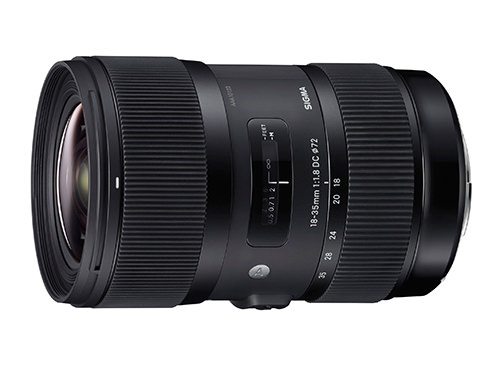
The Sigma xviii-35mm f/1.8 DC HCM is a technological marvel, because information technology is the commencement zoom lens in history with such a wide / fast aperture. On meridian of that, Sigma used many high-terminate features and components that are normally merely available on pro-grade full-frame lenses. First, the lens comes with a hypersonic motor (HSM), which provides silent and fast autofocus.

Second, the lens has a very circuitous optical formula that consists of a total of 17 lens elements in 12 groups, with iv aspherical and 5 depression-dispersion elements. Third, it has a metal mount and a thermally stable composite barrel, which offers greater elasticity than polycarbonate and offers minimal thermal shrinkage with exceptional hardness, something Sigma has only recently started providing on its new generation lenses. And lastly, being an "Fine art" series lens, it is fully compatible with Sigma'due south USB dock that allows micro-adjusting autofocus parameters.

Sigma 18-35mm f/1.8 DC HSM Fine art Specifications
- Available for Mounts: Sigma, Sony, Nikon, Pentax, Catechism
- Focal length: 18-35mm
- Maximum discontinuity: f/1.8
- Minimum aperture: f/16
- Lens construction: 17 elements in 12 groups
- Angle of view: 76.v° – 44.2°
- Closest focusing altitude: 28cm/xi.0in.
- Maximum reproduction ratio: 1:4.3
- No. of diaphragm blades: 9 (rounded)
- Filter/attachment size: 72mm
- Bore x length: 78mm x 121mm / iii.1in. x four.8in.
- Weight: 810g/28.6 oz.

Other technical data, including manufacturer-provided MTF nautical chart can be constitute in the Sigma eighteen-35mm f/i.8 DC HSM page from our lens database.
Lens Treatment and Build
Sigma has put a lot of endeavour into making the new generation lenses attractive both in terms of design and function, and the Sigma 18-35mm is not an exception. Like to the Sigma 35mm f/ane.four Art, the lens gives a different sense of quality to information technology when compared to previous generation Sigma lenses. The craftsmanship of the lens is indeed fantabulous. Starting from the rugged brass mountain that smoothly connects with the metal butt, to the smoothen condom focus ring in the front, yous won't get a feeling of a cheap lens that we are so accustomed to when commonly dealing with APS-C/DX lenses. The metallic butt is made of a special Thermally Stable Blended material, which offers exceptional hardness, better elasticity than polycarbonate and minimal thermal shrinkage. This basically means that the lens should easily withstand extremely hot and cold temperatures without damage or potential operation degradation. While I could not test the lens in hot temperatures, I did take it out during a very cold morning when the temperatures peaked -5F (some of the snow images in the review were taken during that morning time). The lens performed very well during and later the shoot, autofocus continued to role without whatsoever issues, and both zoom and focus rings operated smoothly without getting stuck. In brusque, the build quality of the Sigma 18-35mm is outstanding. My merely gripe is lack of a rubber gasket on the mount to foreclose dust and other droppings from getting into the camera. For some reason, Sigma never includes one on its lenses, which is unfortunate.

The handling of the lens is likewise superb, although that can depend on whether you are comfortable with a reverse rotation of the focus ring. The zoom ring follows similar clock-wise rotation from short to long focal lengths as Nikon's DX lenses, but its focus band is reversed. So to move from close focus to infinity, you would have to rotate the focus band counter clock-wise. Aside from this ergonomic deviation, I accept not seen whatsoever serious issues with handling (and Catechism users might prefer how the focus band works, because Canon lenses work the same mode). Yes, the lens is indeed quite heavy at 810 grams, but considering its fast speed, metallic construction and a total of 17 lens elements, I doubt Sigma could have fabricated information technology lighter. That said, it certainly does experience front end-heavy when mounted on lightweight DX cameras similar Nikon D5300. At the aforementioned fourth dimension, its long barrel really makes it easier to balance it out on lightweight camera bodies when it is hand-held. The zoom ring is smooth and has some nice resistance to it, while the focus ring is too very smoothen, albeit with a footling less resistance. Similar to many Nikkor lenses, at that place is a switch on the side of the butt that allows to move the lens from autofocus to manual focus operation. The middle portion of the butt (which is nicely threaded underneath for improve grip), along with the front role and the filter thread are plastic. Sigma probably decided to employ the lighter material to decrease the weight of the lens. The supplied hood is also plastic and tin can be mounted regularly, or in reverse direction to save camera bag space. Once mounted on the lens, it stays secure and does not wobble.


Use on Full-Frame
Some DX / APS-C lenses are known to work quite well on full-frame cameras, with some vignetting that can be removed in the corners (the Nikon 35mm f/ane.8G is a good example of such lens). The Sigma xviii-35mm f/1.8G is non a good candidate to be mounted on a full-frame camera, especially at the shortest stop of the focal length. Take a look at how the image turned out when I shot it at 18mm on the Nikon D800E:

When I saw the to a higher place, I inverse the setting on my Nikon D800E to switch to DX ingather style when the lens was mounted on information technology.
Autofocus Performance and Accurateness
Thanks to the fast hypersonic motor, the lens acquires focus quickly and silently. I compared the AF speed of the Sigma 18-35mm f/1.8 to the Nikon 50mm f/i.8G and while the Nikon seemed to exist a tad faster, it was definitely noisier. Also, it is of import to notation that unlike older lenses that required cameras to take a built-in autofocus motor, the Sigma 18-35mm has an integrated focus motor, which ways that autofocus will work on entry-level cameras like Nikon D3300 and D5300. With lenses with built-in focus motors, you exercise not have to worry about buying a higher-end DSLR just to be able to utilise autofocus anymore.

In terms of autofocus accuracy, the lens behaved rather unpredictably at times. While most of the images were in focus, sometimes the lens would merely refuse to acquire correct focus on both the Nikon D5300 and the Nikon D800E (in DX crop fashion). And when the light conditions were less than ideal pressing the AF-ON button repeatedly to force the lens to reacquire focus would non assist either. Occasionally, I would extend my mitt at a close distance, forcefulness the lens to acquire focus, then refocus on the subject. I don't know if this has to do with Nikon firmware not playing well with Sigma, or if it is Sigma'due south AF motor that is unreliable, but it certain was disappointing to accept a shot simply to detect out that the lens focused on the groundwork. Utilizing the heart focus indicate and using the focus and recompose technique in low-light and high-contrast situations seemed to yield ameliorate results.


champagnecionse86.blogspot.com
Source: https://photographylife.com/reviews/sigma-18-35mm-f1-8
0 Response to "Sigma 1835mm F18 Art Dc Hsm for Sony E Mount"
Postar um comentário