What three lines of evidence can be used to infer common ancestry in organisms?
Along path leads from the origins of primitive "life," which existed at least 3.5 billion years ago, to the profusion and diversity of life that exists today. This path is best understood as a product of evolution.
Contrary to pop opinion, neither the term nor the idea of biological evolution began with Charles Darwin and his foremost work, On the Origin of Species past Means of Natural Selection (1859). Many scholars from the ancient Greek philosophers on had inferred that like species were descended from a common ancestor. The discussion "development" get-go appeared in the English language in 1647 in a nonbiological connectedness, and information technology became widely used in English language for all sorts of progressions from simpler beginnings. The term Darwin virtually often used to refer to biological development was "descent with modification," which remains a practiced cursory definition of the process today.
Darwin proposed that development could be explained by the differential survival of organisms following their naturally occurring variation—a procedure he termed "natural selection." According to this view, the offspring of organisms differ from one another and from their parents in ways that are heritable—that is, they can pass on the differences genetically to their ain offspring. Furthermore, organisms in nature typically produce more offspring than can survive and reproduce given the constraints of food, space, and other environmental resources. If a particular offspring has traits that give it an advantage in a particular environment, that organism will be more likely to survive and pass on those traits. Every bit differences accumulate over generations, populations of organisms diverge from their ancestors.
Effigy
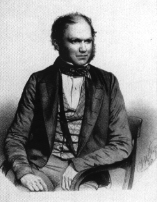
Charles Darwin arrived at many of his insights into evolution by studying the variations among species on the Galápagos Islands off the declension of Republic of ecuador.
Darwin's original hypothesis has undergone extensive modification and expansion, but the central concepts stand up business firm. Studies in genetics and molecular biology—fields unknown in Darwin'south time—have explained the occurrence of the hereditary variations that are essential to natural selection. Genetic variations effect from changes, or mutations, in the nucleotide sequence of Deoxyribonucleic acid, the molecule that genes are made from. Such changes in Deoxyribonucleic acid now tin be detected and described with great precision.
Genetic mutations ascend by chance. They may or may not equip the organism with amend means for surviving in its surroundings. But if a gene variant improves accommodation to the environment (for instance, by allowing an organism to make amend apply of an available nutrient, or to escape predators more finer—such every bit through stronger legs or disguising coloration), the organisms carrying that factor are more likely to survive and reproduce than those without information technology. Over time, their descendants volition tend to increase, irresolute the average characteristics of the population. Although the genetic variation on which natural selection works is based on random or chance elements, natural selection itself produces "adaptive" alter—the very opposite of hazard.
Scientists also have gained an understanding of the processes by which new species originate. A new species is one in which the individuals cannot mate and produce viable descendants with individuals of a preexisting species. The split of ane species into two often starts because a group of individuals becomes geographically separated from the rest. This is particularly credible in afar remote islands, such as the Galápagos and the Hawaiian archipelago, whose slap-up altitude from the Americas and Asia means that arriving colonizers will have niggling or no opportunity to mate with individuals remaining on those continents. Mountains, rivers, lakes, and other natural barriers too business relationship for geographic separation between populations that once belonged to the same species.
One time isolated, geographically separated groups of individuals become genetically differentiated equally a outcome of mutation and other processes, including natural selection. The origin of a species is often a gradual process, then that at outset the reproductive isolation betwixt separated groups of organisms is but partial, but it eventually becomes complete. Scientists pay special attention to these intermediate situations, because they help to reconstruct the details of the procedure and to identify particular genes or sets of genes that account for the reproductive isolation between species.
A specially compelling example of speciation involves the 13 species of finches studied by Darwin on the Galápagos Islands, now known as Darwin'south finches. The ancestors of these finches appear to accept immigrated from the South American mainland to the Galápagos. Today the dissimilar species of finches on the isle have distinct habitats, diets, and behaviors, but the mechanisms involved in speciation go along to operate. A research grouping led past Peter and Rosemary Grant of Princeton University has shown that a unmarried twelvemonth of drought on the islands can drive evolutionary changes in the finches. Drought diminishes supplies of easily cracked basics but permits the survival of plants that produce larger, tougher nuts. Droughts thus favor birds with potent, wide beaks that tin break these tougher seeds, producing populations of birds with these traits. The Grants have estimated that if droughts occur about once every x years on the islands, a new species of finch might arise in but about 200 years.

Figure
The dissimilar species of finches on the Galápagos Islands, now known as Darwin'due south finches, have different-sized beaks that take evolved to take advantage of distinct nutrient sources.
The following sections consider several aspects of biological development in greater detail, looking at paleontology, comparative anatomy, biogeography, embryology, and molecular biology for further evidence supporting evolution.
The Fossil Record
Although information technology was Darwin, above all others, who first marshaled convincing evidence for biological evolution, earlier scholars had recognized that organisms on Earth had changed systematically over long periods of fourth dimension. For case, in 1799 an engineer named William Smith reported that, in undisrupted layers of rock, fossils occurred in a definite sequential order, with more modern-appearing ones closer to the superlative. Because bottom layers of rock logically were laid down before and thus are older than top layers, the sequence of fossils likewise could be given a chronology from oldest to youngest. His findings were confirmed and extended in the 1830s by the paleontologist William Lonsdale, who recognized that fossil remains of organisms from lower strata were more than primitive than the ones above. Today, many thousands of ancient rock deposits take been identified that bear witness corresponding successions of fossil organisms.
Thus, the general sequence of fossils had already been recognized before Darwin conceived of descent with modification. Only the paleontologists and geologists before Darwin used the sequence of fossils in rocks not as proof of biological evolution, but as a basis for working out the original sequence of rock strata that had been structurally disturbed by earthquakes and other forces.
In Darwin's fourth dimension, paleontology was even so a rudimentary scientific discipline. Large parts of the geological succession of stratified rocks were unknown or inadequately studied.

Figure
A geological cross section of the 1000 Staircase-Escalante National Monument in Utah shows layers of sedimentary rock. These layers reveal deposits laid down over millions of years. Older fossils are institute in the lower layers, revealing the succession (more...)

Effigy
Weathering has exposed layers of sedimentary rock near the Paria River in Utah
Darwin, therefore, worried about the rarity of intermediate forms between some major groups of organisms.
Today, many of the gaps in the paleontological record take been filled past the research of paleontologists. Hundreds of thousands of fossil organisms, found in well-dated stone sequences, represent successions of forms through time and manifest many evolutionary transitions. As mentioned earlier, microbial life of the simplest type was already in existence 3.5 billion years ago. The oldest bear witness of more complex organisms (that is, eucaryotic cells, which are more than complex than leaner) has been discovered in fossils sealed in rocks approximately 2 billion years old. Multicellular organisms, which are the familiar fungi, plants, and animals, take been found only in younger geological strata. The following list presents the order in which increasingly complex forms of life appeared:
View in ain window
| Life Form | Millions of Years Since First Known Appearance (Approximate) |
|---|---|
| Microbial (procaryotic cells) | 3,500 |
| Complex (eucaryotic cells) | two,000 |
| First multicellular animals | 670 |
| Beat-bearing animals | 540 |
| Vertebrates (uncomplicated fishes) | 490 |
| Amphibians | 350 |
| Reptiles | 310 |
| Mammals | 200 |
| Nonhuman primates | threescore |
| Primeval apes | 25 |
| Australopithecine ancestors of humans | five |
| Modernistic humans | 0.15 (150,000 years) |
So many intermediate forms accept been discovered between fish and amphibians, between amphibians and reptiles, betwixt reptiles and mammals, and along the primate lines of descent that it frequently is difficult to identify categorically when the transition occurs from one to another particular species. Really, virtually all fossils can be regarded as intermediates in some sense; they are life forms that come betwixt the forms that preceded them and those that followed.
The fossil record thus provides consistent evidence of systematic modify through time—of descent with modification. From this huge body of evidence, it can be predicted that no reversals will exist found in futurity paleontological studies. That is, amphibians will not appear before fishes, nor mammals before reptiles, and no complex life will occur in the geological record before the oldest eucaryotic cells. This prediction has been upheld by the evidence that has accumulated until now: no reversals have been constitute.
Mutual Structures
Inferences most common descent derived from paleontology are reinforced by comparative anatomy. For instance, the skeletons of humans, mice, and bats are strikingly similar, despite the dissimilar ways of life of these animals and the diversity of environments in which they flourish. The correspondence of these animals, os by bone, can be observed in every part of the body, including the limbs; yet a person writes, a mouse runs, and a bat flies with structures built of basic that are dissimilar in detail but similar in general structure and relation to each other.
Scientists call such structures homologies and have ended that they are all-time explained past common descent. Comparative anatomists investigate such homologies, not only in bone construction but also in other parts of the body, working out relationships from degrees of similarity. Their conclusions provide important inferences about the details of evolutionary history, inferences that tin exist tested by comparisons with the sequence of bequeathed forms in the paleontological tape.

Figure
A bat wing, a mouse forelimb, and a human arm serve very different purposes, but they have the aforementioned basic components The similarities arise because all three species share a mutual four-limbed vertebrate ancestor
The mammalian ear and jaw are instances in which paleontology and comparative anatomy combine to show common ancestry through transitional stages. The lower jaws of mammals contain only one os, whereas those of reptiles take several. The other basic in the reptile jaw are homologous with basic now plant in the mammalian ear. Paleontologists take discovered intermediate forms of mammal-like reptiles (Therapsida) with a double jaw articulation—i composed of the bones that persist in mammalian jaws, the other consisting of basic that eventually became the hammer and anvil of the mammalian ear.
The Distribution of Species
Biogeography also has contributed evidence for descent from mutual ancestors. The diverseness of life is stupendous. Approximately 250,000 species of living plants, 100,000 species of fungi, and ane million species of animals have been described and named, each occupying its own peculiar ecological setting or niche; and the demography is far from complete. Some species, such equally human beings and our companion the dog, tin live nether a wide range of environments. Others are amazingly specialized. I species of a fungus (Laboulbenia) grows exclusively on the rear portion of the covering wings of a single species of beetle (Aphaenops cronei) establish only in some caves of southern France. The larvae of the wing Drosophila carcinophila can develop but in specialized grooves beneath the flaps of the third pair of oral appendages of a state crab that is establish only on sure Caribbean islands.
How can we make intelligible the colossal diversity of living beings and the existence of such boggling, seemingly whimsical creatures every bit the fungus, beetle, and fly described above? And why are island groups like the Galápagos and then often inhabited past forms like to those on the nearest mainland but belonging to different species? Evolutionary theory explains that biological diversity results from the descendants of local or migrant predecessors condign adapted to their diverse environments. This explanation tin exist tested by examining nowadays species and local fossils to encounter whether they accept similar structures, which would betoken how ane is derived from the other. Also, there should be evidence that species without an established local beginnings had migrated into the locality.
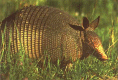
Wherever such tests accept been carried out, these conditions have been confirmed. A expert case is provided by the mammalian populations of North and S America, where strikingly different native organisms evolved in isolation until the emergence of the isthmus of Panama approximately 3 million years agone. Thereafter, the armadillo, porcupine, and opossum—mammals of South American origin—migrated northward, forth with many other species of plants and animals, while the mountain king of beasts and other North American species fabricated their way beyond the isthmus to the s.
The evidence that Darwin found for the influence of geographical distribution on the development of organisms has become stronger with advancing noesis. For example, approximately two,000 species of flies belonging to the genus Drosophila are now found throughout the world. About one-quarter of them live only in Hawaii.
Figure
Until about iii 1000000 years ago, Due north and Due south America were separated by a wide expanse of water, so mammals on the two continents evolved separately. Afterward the isthmus of Panama formed, armadillos and opossums migrated north, and mountain lions migrated (more...)
More than a g species of snails and other state mollusks also are establish only in Hawaii. The biological caption for the multiplicity of related species in remote localities is that such great diversity is a issue of their evolution from a few mutual ancestors that colonized an isolated environment. The Hawaiian Islands are far from any mainland or other islands, and on the basis of geological show they never have been fastened to other lands. Thus, the few colonizers that reached the Hawaiian Islands found many bachelor ecological niches, where they could, over numerous generations, undergo evolutionary change and diversification. No mammals other than i bat species lived in the Hawaiian Islands when the first human settlers arrived; similarly, many other kinds of plants and animals were absent.
The Hawaiian Islands are not less hospitable than other parts of the world for the absent species. For example, pigs and goats accept multiplied in the wild in Hawaii, and other domestic animals also thrive there. The scientific explanation for the absence of many kinds of organisms, and the corking multiplication of a few kinds, is that many sorts of organisms never reached the islands, because of their geographic isolation. Those that did reach the islands diversified over fourth dimension because of the absence of related organisms that would compete for resources.
Similarities During Development
Embryology, the written report of biological evolution from the time of conception, is another source of independent evidence for common descent. Barnacles, for instance, are sedentary crustaceans with little credible similarity to such other crustaceans as lobsters, shrimps, or copepods. Notwithstanding barnacles pass through a complimentary-swimming larval stage in which they look like other crustacean larvae. The similarity of larval stages supports the determination that all crustaceans have homologous parts and a common ancestry.
Similarly, a wide variety of organisms from fruit flies to worms to mice to humans have very like sequences of genes that are agile early in development. These genes influence body segmentation or orientation in all these various groups. The presence of such similar genes doing similar things across such a broad range of organisms is all-time explained by their having been present in a very early common ancestor of all of these groups.
New Evidence from Molecular Biology
The unifying principle of common descent that emerges from all the foregoing lines of evidence is existence reinforced by the discoveries of modern biochemistry and molecular biology.
The code used to interpret nucleotide sequences into amino acrid sequences is substantially the same in all organisms. Moreover, proteins in all organisms are invariably composed of the same set of 20 amino acids. This unity of composition and office is a powerful argument in favor of the common descent of the most various organisms.
In 1959, scientists at Cambridge University in the United kingdom of great britain and northern ireland determined the three-dimensional structures of two proteins that are constitute in almost every multicelled animal: hemoglobin and myoglobin. Hemoglobin is the poly peptide that carries oxygen in the blood. Myoglobin receives oxygen from hemoglobin and stores it in the tissues until needed. These were the get-go three-dimensional protein structures to be solved, and they yielded some key insights. Myoglobin has a single chain of 153 amino acids wrapped around a group of iron and other atoms (called "heme") to which oxygen binds. Hemoglobin, in contrast, is fabricated of up four chains: two identical bondage consisting of 141 amino acids, and two other identical bondage consisting of 146 amino acids. Still, each concatenation has a heme exactly similar that of myoglobin, and each of the 4 chains in the hemoglobin molecule is folded exactly like myoglobin. It was immediately obvious in 1959 that the ii molecules are very closely related.
During the adjacent two decades, myoglobin and hemoglobin sequences were determined for dozens of mammals, birds, reptiles, amphibians, fish, worms, and molluscs. All of these sequences were so obviously related that they could exist compared with confidence with the iii-dimensional structures of ii selected standards—whale myoglobin and horse hemoglobin. Even more significantly, the differences between sequences from different organisms could be used to construct a family tree of hemoglobin and myoglobin variation among organisms. This tree agreed completely with observations derived from paleontology and anatomy about the common descent of the corresponding organisms.

Figure
Myoglobin, which stores oxygen in muscles, consists of a chain of 153 amino acids wrapped effectually an oxygen-bounden molecule. The sequence of amino acids in myoglobin vanes from species to species, revealing the evolutionary relationships among organisms. (more...)
Similar family histories accept been obtained from the three-dimensional structures and amino acid sequences of other proteins, such every bit cytochrome c (a poly peptide engaged in energy transfer) and the digestive proteins trypsin and chymotrypsin. The examination of molecular structure offers a new and extremely powerful tool for studying evolutionary relationships. The quantity of information is potentially huge—as large as the thousands of unlike proteins contained in living organisms, and limited only by the time and resource of molecular biologists.
Equally the power to sequence the nucleotides making up DNA has improved, it also has become possible to employ genes to reconstruct the evolutionary history of organisms. Because of mutations, the sequence of nucleotides in a cistron gradually changes over time. The more closely related two organisms are, the less different their Dna will be. Considering in that location are tens of thousands of genes in humans and other organisms, Deoxyribonucleic acid contains a tremendous amount of information nearly the evolutionary history of each organism.
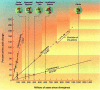
Genes evolve at different rates considering, although mutation is a random outcome, some proteins are much more than tolerant of changes in their amino acid sequence than are other proteins. For this reason, the genes that encode these more tolerant, less constrained proteins evolve faster The boilerplate rate at which a particular kind of gene or protein evolves gives rise to the concept of a "molecular clock." Molecular clocks run rapidly for less constrained proteins and slowly for more than constrained proteins, though they all time the same evolutionary events.
The figure on this page compares 3 molecular clocks: for cytochrome c proteins, which interact intimately with other macromolecules and are quite constrained in their amino acid sequences; for the less rigidly constrained hemoglobins, which interact mainly with oxygen and other small molecules; and for fibrinopeptides, which are protein fragments that are cut from larger proteins (fibrinogens) when blood clots. The clock for fibrinopeptides runs rapidly; 1 percent of the amino acids alter in a piffling longer than 1 million years. At the other farthermost, the molecular clock runs slowly for cytochrome c; a one percent modify in amino acrid sequence requires xx meg years. The hemoglobin clock is intermediate.
The concept of a molecular clock is useful for 2 purposes. It determines evolutionary relationships among organisms, and information technology indicates the time in the past when species started to diverge from one another. One time the clock for a particular gene or poly peptide has been calibrated by reference to some consequence whose time is known, the bodily chronological time when all other events occurred can be determined by examining the protein or factor tree.
Figure
Species that diverged longer ago have more differences in their respective proteins, reflecting changes in the amino acids over fourth dimension. Proteins evolve at different rates depending on the constraints imposed by their functions. Cytochrome c, a poly peptide (more...)
An interesting additional line of prove supporting development involves sequences of DNA known equally "pseudogenes." Pseudogenes are remnants of genes that no longer function but continue to exist carried along in Deoxyribonucleic acid as excess luggage. Pseudogenes also change through time, equally they are passed on from ancestors to descendants, and they offer an especially useful way of reconstructing evolutionary relationships.
With functioning genes, one possible caption for the relative similarity between genes from different organisms is that their ways of life are like—for example, the genes from a horse and a zebra could be more similar because of their similar habitats and behaviors than the genes from a horse and a tiger. Simply this possible caption does not work for pseudogenes, since they perform no function. Rather, the caste of similarity between pseudogenes must merely reverberate their evolutionary relatedness. The more remote the terminal common ancestor of two organisms, the more dissimilar their pseudogenes volition be.
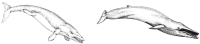
The evidence for evolution from molecular biology is overwhelming and is growing quickly. In some cases, this molecular evidence makes information technology possible to go beyond the paleontological evidence. For instance, it has long been postulated that whales descended from land mammals that had returned to the sea. From anatomical and paleontological evidence, the whales' closest living land relatives seemed to be the fifty-fifty-toed hoofed mammals (modem cattle, sheep, camels, goats, etc.).
Recent comparisons of some milk protein genes (beta-casein and kappa-casein) have confirmed this relationship and take suggested that the closest land-spring living relative of whales may be the hippopotamus. In this case, molecular biology has augmented the fossil record.
Creationism and the Evidence for Evolution
Some creationists cite what they say is an incomplete fossil record as prove for the failure of evolutionary theory. The fossil record was incomplete in Darwin's fourth dimension, but many of the important gaps that existed then have been filled by subsequent paleontological research. Perhaps the most persuasive fossil evidence for evolution is the consistency of the sequence of fossils from early on to contempo. Nowhere on Earth practise we find, for case, mammals in Devonian (the age of fishes) strata, or human fossils circumstantial with dinosaur remains. Undisturbed strata with simple unicellular organisms predate those with multicellular organisms, and invertebrates precede vertebrates; nowhere has this sequence been constitute inverted. Fossils from adjacent strata are more like than fossils from temporally afar strata. The about reasonable scientific conclusion that can exist drawn from the fossil record is that descent with modification has taken place every bit stated in evolutionary theory.

Figure
Mammakian land ancestor Ambulocetus
Special creationists argue that "no one has seen evolution occur." This misses the point virtually how science tests hypotheses. We don't see Earth going around the sun or the atoms that make upward matter. We "encounter" their consequences. Scientists infer that atoms exist and Earth revolves because they have tested predictions derived from these concepts by extensive observation and experimentation.
Furthermore, on a pocket-sized scale, we "experience" evolution occurring every twenty-four hour period. The annual changes in flu viruses and the emergence of antibiotic-resistant bacteria are both products of evolutionary forces. Indeed, the rapidity with which organisms with curt generation times, such as bacteria and viruses, tin can evolve under the influence of their environments is of great medical significance. Many laboratory experiments have shown that, because of mutation and natural selection, such microorganisms can change in specific means from those of immediately preceding generations.
On a larger scale, the evolution of mosquitoes resistant to insecticides is some other example of the tenacity and adaptability of organisms under environmental stress. Similarly, malaria parasites have become resistant to the drugs that were used extensively to combat them for many years. As a consequence, malaria is on the increment, with more than 300 million clinical cases of malaria occurring every year.
Molecular evolutionary data counter a recent proposition chosen "intelligent design theory." Proponents of this thought argue that structural complexity is proof of the straight mitt of God in specially creating organisms as they are today. These arguments repeat those of the 18th century cleric William Paley who held that the vertebrate heart, because of its intricate organization, had been specially designed in its present form by an omnipotent Creator. Modem-day intelligent design proponents argue that molecular structures such as Dna, or molecular processes such as the many steps that blood goes through when it clots, are and so irreducibly complex that they can office merely if all the components are operative at once. Thus, proponents of intelligent blueprint say that these structures and processes could not have evolved in the stepwise mode feature of natural choice.
Figure
Rodhocetus Balaenoptera (modern Bluish whale)
However, structures and processes that are claimed to be "irreducibly" complex typically are not on closer inspection. For case, it is wrong to presume that a circuitous structure or biochemical process can function only if all its components are present and functioning as nosotros encounter them today. Complex biochemical systems can be built upward from simpler systems through natural option. Thus, the "history" of a protein tin be traced through simpler organisms. Jawless fish have a simpler hemoglobin than do jawed fish, which in turn have a simpler hemoglobin than mammals.
The evolution of complex molecular systems can occur in several ways. Natural option can bring together parts of a system for one part at ane fourth dimension and then, at a later fourth dimension, recombine those parts with other systems of components to produce a system that has a different role. Genes can be duplicated, altered, and and so amplified through natural selection. The complex biochemical pour resulting in blood clotting has been explained in this manner.
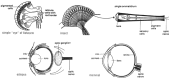
Similarly, evolutionary mechanisms are capable of explaining the origin of highly complex anatomical structures. For case, eyes may have evolved independently many times during the history of life on Earth. The steps keep from a simple eye spot fabricated up of light-sensitive retinula cells (as is now found in the flatworm), to formation of individual photosensitive units (ommatidia) in insects with lite focusing lenses, to the eventual germination of an centre with a single lens focusing images onto a retina. In humans and other vertebrates, the retina consists non only of photoreceptor cells merely too of several types of neurons that begin to clarify the visual image. Through such gradual steps, very dissimilar kinds of optics accept evolved, from simple calorie-free-sensing organs to highly complex systems for vision.
Figure
Eyes evolved over many millions of years from elementary organs that can detect light.
champagnecionse86.blogspot.com
Source: https://www.ncbi.nlm.nih.gov/books/NBK230201/
0 Response to "What three lines of evidence can be used to infer common ancestry in organisms?"
Postar um comentário